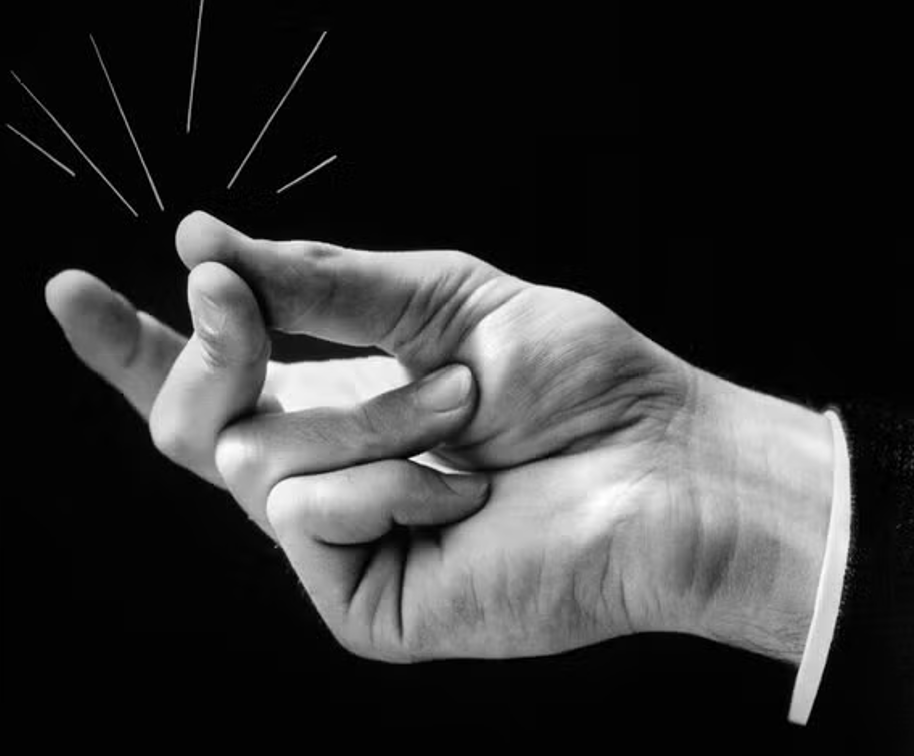
One of the more fascinating rabbit holes I have gone down in magic over the last decade is what might loosely be called the Ascanian Conception of Magic.
Within this framework, Ascanio provided the overall skeleton, while Juan Tamariz and Luis García add further ideas on top of that framework. However, what really took off for me was studying Gabi Pareras’ work on Fictional Magic.
Gabi sadly left us far too early in 2020, but he left behind a large body of work that allows a newer generation of magicians to continue exploring his ideas.
The following text came out of reading and studying Pedro Bryce’s writing from his book Reminiscencias. Pedro has an extraordinary amount of knowledge, and some of the best handling of Ace Assemblies and Triumph routines I have ever come across. If you ever have a chance to see his Ace Assembly in person, by all means do so. I have performed his particular seven-card Ace Assembly for both magicians and lay audiences, and it consistently gets a very strong reaction. I should also mention that the routine was published in Steve Beam’s Semi-Automatic Card Tricks, which, as far as I know, is the only text by Pedro currently available in English.
What Is the Magic Gesture?
Gesto Mágico, broadly translated as Magic Gesture, is a term that appears throughout much of Gabi’s writing.
Broadly speaking, and as I understand it, the Magic Gesture is the action that alerts the spectator that the Magical Moment is taking place, with this magic gesture sits between the Initial Situation and the Final Situation.
One useful way to understand the relationship between the Initial Situation, Magic Gesture, and Final Situation is through a video essay I came across on Youtube.
The video essay above provides a useful framework for critically examining how magic is portrayed in popular media. In particular, the video criticizes the way Marvel depicts magic in Doctor Strange in the Multiverse of Madness.
The scene in question involves the confrontation between Scarlet Witch and Black Bolt.
In one moment, Black Bolt has a mouth and was talking to Scarlet Witch. A moment later, his mouth has disappeared, eventually leading to his unpleasant death.
We are given a clear Initial Situation and a clear Final Situation, but there is almost nothing perceptible connecting the two. What we get is essentially a brief stare from Scarlet Witch, followed immediately by the resultant outcome. For anyone who has followed Marvel and watched the character develop over time, the natural question would be: where did this power come from? There is also no clear transition or esbalished cue connecting her stare to what happens next.
The transformation occurs out of nowhere with very little for the viewer to attach the magical cause to.
Two useful comparisons can be drawn from more familiar superhero actions.
Superman does not simply stand still in one frame and appear airborne in the next. He crouches, compresses his body, and then launches upward.
Similarly, Spider-Man extends his arm and forms the distinctive hand position associated with firing a web.
Neither action scientifically explains the super power. However, what they do provide is a clear and specific transition and causation.
The ‘action’ does not need to be logical, nor does it need to explain the power in a rational way. What it does is give the audience a perceptible bridge between the Initial Situation and the Final Situation.
There is also a question of consistency. The power should feel consistent with the character and with the phenomenon that has already been established. The Scarlet Witch we have come to know usually moves her hands when manipulating objects or directing her powers. There is very little established association between a plain stare and this kind of physical transformation.
With a Magic Gesture, the spectator is given something to connect the impossible event to. That action becomes the dramatic boundary through which the viewer understands that the Magical Moment is taking place.
Applying the magic Gesture
There are countless forms a Magical Gesture can take. Suppose a signed card is placed in the middle of the deck (Initial Situation).
Something dramatic, unique, or unusual action happens. The magician may press a finger onto the top of the deck. Perhaps the spectator says the name of the card. Perhaps the magician simply raise his hand up a few inches. (Magic Gesture).
Then the chosen card is shown on top (Final Situation).
According to Pedro Bryce and Mano Montes, Magic Gesture is not confined to physical actions. It can just as easily be: a word, a phrase, a pause, or even silence. Whatever form it takes, It needs to provides a linkage to the phenomenon that is taking place.
Pedro Bryce further provides a useful analogy in Reminiscencias: the Magic Gesture can be thought of as a switch.
When the appropriate moment arrives, the switch is activated and something specific happens.
A light switch turns on a particular light. However, It does not also turn on the television, boil the kettle, open the garage door and start the washing machine. The Magic Gesture has to be specific and has a sense of identity.
This is also why the finger snap, as commonly used by magicians, can sometimes feel redundant or empty. The problem is not the snap itself, but that it often has no meaningful relationship with the phenomenon being presented.
A snap can work perfectly well if the effect is meant to feel sudden, instantaneous, or triggered by a sharp impulse. However, if the same snap makes a coin vanish, restores a torn card, causes two objects to transpose, changes the color of a card, and makes a thought appear, then the gesture starting to lost its meaning.
The question that I found most useful when introducing a Magic Gesture is by asking the following question:
What does the spectator understand this action to mean?
If I tap the deck and then reveal that the card has risen, what did the tap actually mean?
If I blow on a torn piece of paper and it restores itself, what does the breath suggest?
If I turn an imaginary dial backwards and the deck returns to an earlier condition, what has that movement expressed?
The Magic Gesture becomes much more interesting when it belongs to the phenomenon rather than simply being there between the Initial Situation and the Final Situation without any real connection to what is happening.
Below are some of my favourite examples of Magic Gestures that I have come across.
A Moment in Time by Think Nguyen
In this effect, the Ace of Spades is shown face up on top of the deck and then buried inside.
The deck then mysteriously rotates, seemingly on its own accord, until the Ace is shown back on top.
There is a second phase involved which allow a transposition of two cards to occur. However, I think that the first phase sufficiently address the phenomenon that is happening.
Rather than presenting this simply as an Ambitious Card routine, the gesture suggests that we are moving through time.
Move something counterclockwise and perhaps we are travelling backwards in time.
Move it clockwise again and perhaps we are returning to the present.
In this particular moment, the deck itself is no longer the real subject of the effect.
The real phenomenon is time itself.
John Bannon’s Take on Daley’s Last Trick
In John Bannon’s handling of Dr. Daley’s Last Trick from Dear Mr. Fantasy, the spectator holds the supposed red Aces, one in each hand, while the magician holds the black Aces. Bannon then physically crosses and uncrosses the spectator’s hands before revealing that the red and black Aces have transposed.
In this particular phenomenon, the Magic Gesture is performed using the spectator’s own hands. The crossing and uncrossing action creates a physical image of the cards changing places, giving the later transposition a clear sense of movement. The magician provides the context, while the spectator fills in the meaning. The gesture not only illustrates the transposition itself, but also makes the magic feel as though it is happening directly within the spectator’s hands.
Undo – The jerx
In this trick, the Magic Gesture does not come from the magician directly. Instead, it comes from an external influence that appears to act on the trick itself.
The performer first demonstrates that an email can be sent and then quickly retrieved by clicking an “undo” bottom.
From there, the same idea is applied to a deck of cards. The cards are shuffled face up into face down, an email describing that action is sent, and when the ‘Undo’ bottom is clicked , the deck is shown to have corrected itself so that every card is facing the same way.
As can be seen above, this is a classic Triumph effect, however, there is no finger snap, wave of the hand, or mysterious spell (these actions are perfectly justifiable, if the context allow).
The spectator already understands what the button is supposed to do before the magic even begins. The performer provides the context, and the spectator extends that meaning from the email to the deck of cards.
In this case, the external environment becomes part of the magical cause. The button acts as the Magic Gesture, even though it sits outside the deck and outside the magician’s physical present.
A Vocabulary of Possible Magic Gestures
Once I started looking at the phenomenon that could happen to an object, I began noticing possible Magic Gestures…
Some are physical:
Rubbing the hand – Jennings Revelation by Larry Jennings
Twisting the card – Twisting the Aces by Dai Vernon
Pinching something from the air – Miser’s Dream as performed by Jeff McBride
Bringing two fingertips together – Coin for Connoisseurs by Ron Aldrich
Interlacing the fingers – Oil and Water by Juan Tamariz
Crossing and uncrossing the hands – Dr. Daley’s Last Trick as performed by John Bannon
Drawing an invisible line – Eric Chien’s FISM act & Invisible Thread by Helder Guimarães
Tracing a circle – Pen Through Coin as performed by Miguel Ángel Gea
Casting a shadow over a deck of cards – Haunted Deck as performed by Asi Wind
Turning the hand over – Triunfo al Palo by Pedro Bryce
Breathing in and out – Coin Matrix as performed by Mott-Sun
Others are not really physical gestures at all. They can be a word, a phrase, a countdown, a whisper, a whistle, a change in vocal tone, or a pause.
Others may come from the environment surrounding the performance and the audience: a light turning on or off, a change in music, or even a photograph hanging on the wall.
The possibilities are almost endless, and are there waiting for us to explore.

Leave a Reply