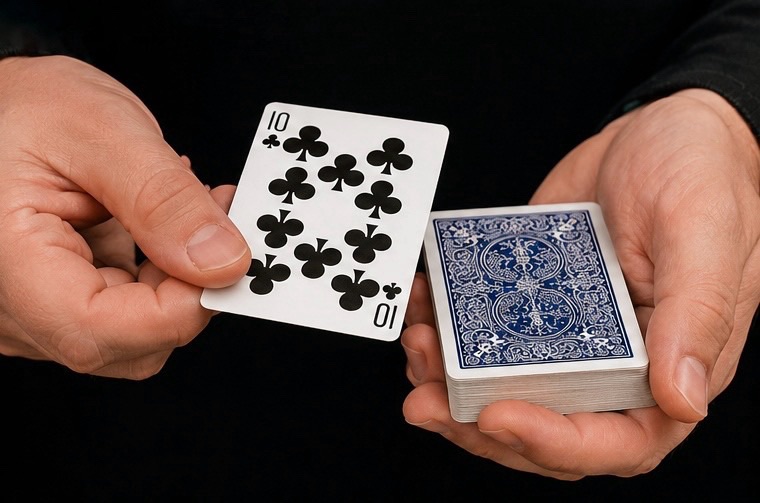
I still remember the first Double Lift I was taught. It was during a four-day beginner magic course held upstairs in a local magic shop, aimed at people with little or no experience to magic.
Looking back, what surprised me was how early the Double Lift appeared in the curriculum (second day). For an absolute beginner, I would have thought it was something better left until the very end, if it needed to be taught at all. I had expected the first few lessons to be filled with tricks and self-working material designed to spark our interest, but I digress.
The method we were taught was Dr. Jacob Daley’s Strike Double Lift, which now seems like a rather unusual choice. The only reason I could think of was that, for someone who has only just started card magic, the idea of secretly holding a break beneath the double is not necessarily intuitive and may seem rather daunting.
At that stage, you are probably not yet thinking about the context in which the break is obtained, the psychology behind covering the action, the “intellectual movement” of establishing a break, as coined by Ascanio, or even something as basic as how large that size of break should be. Compared with all of that above, simply reaching over and picking off the double with the fingertip probably sounds like the safer option.
Over the years, though, I have not seen many Strike Doubles that looked completely natural to me. Jonathan Kamm’s handling is probably the best example I have come across. What makes his Strike Double look so good is how consistently he can hit the double with almost no hesitation or fumbling. There are multiple videos of him performing his Ambitious Card routines on YouTube that is well worth studying.
Even then, the Strike Double still strikes me (no pun intended) as a rather unusual way of picking up a card. Over the years, though, I have come to appreciate that there is a reason for keeping a move such as Strike Double in one’s technical library (see below for further detail).
At that time, I abandoned the Strike Double and began exploring other options.
Like most magicians starting out, I began searching for the “best” method, and have became increasingly interested in how many different ways there were to accomplish essentially the same thing.
As a result, I have accumulated a fairly large arsenal of Double Lifts and Turnovers, some used regularly and a few that I use for some special circumstances.
Among the ones that stayed with me are Vernon’s Push-Off, Steve Draun’s Push-Off Double, Shane Cobalt’s Push-Off handling, the Stuart Gordon Double Lift, Harry Lorayne’s Kick Double, Paul Curry’s Drawback Double, Michael Vincent’s takes on the One-Hand Double, Bob White’s Flash Double, Brother John Hamman’s small-packet double handling, Ascanio’s Floating Double, Michael Close’s MC Spread Double, and Jack Parker’s Ballerina Double.
I have used almost all of them in actual routines.
Which brings me back to one of the perennial questions in card magic:
What is the best technique for executing a Double Lift?
I am probably not the person with any authority to give a definitive answer to that question. But having spent a good part of the last twenty years working on these different techniques, and having used most of them in actual routines, I can at least offer my own opinion.
And my answer is: yes.
This may sound like a cop-out. However, after working through enough of them, I no longer judge a Double Lift in isolation. I have come to believe that its value depends largely on the context in which it is used.
A sleight exists to solve a problem, as rightly pointed out by Roberto Giobbi. Different tricks and different performing environment will present different challenges and problems to solve.
You may be given an old deck during a performance. You may be working with a thinner packet. One of your hands may be occupied. You may need to extract a double from the centre of the deck. There are all sorts of situations where a different strategy may be called for.
In those situations, insisting on using the “best” Double Lift, or simply your “favorite” method, can become a problem in itself.
Dani DaOrtiz has talked extensively about naturalness in performance. The audience should understand why the deck is being spread, why the card case is being placed on the table, and why a card is being removed the way it is.
Once an action appears without a clear reason, for example, executing a One-Hand Double Lift when your right hand is perfectly capable of coming over to turn the top card, the move can start to feel out of place, even if it is technically perfect and aesthetically pleasing.
The best Double Lift, then, in my opinion, is the one that, in that particular moment, most closely resembles how you would have handled a single card in the given situation.
Vernon’s Double Lift, if executed exactly as described in The Dai Vernon Book of Magic, can fit naturally into the action of squaring the deck.
Bob White’s Flash Double makes sense when you simply want the audience to catch a quick glimpse of the card.
Paul Curry’s Drawback Double makes sense when you, as a magician, want to look at the card yourself.
A One-Hand Double Lift makes sense when the other hand is occupied, whether you are holding a glass, a card box, or something else.
Once I started thinking about Double Lifts less as competing techniques and more as solutions to different handling problems, even the Strike Double began to look natural to me.
If the audience has already seen that your fingers are dry and that you sometimes having difficulty to push the card out from top of the deck, you have no other choice but to pick off the card this way. Then Striking Double no longer feels like an action introduced only for the move. It is simply consistent with the way you have already been handling the cards (Priming the artifice as Armando Lucero called it).
In that context, the Strike Double stops feeling like an awkward compromise and becomes another useful weapon in magician’s toolbox.
As an additional thought: I have always felt that Michael Close’s MC Spread Double is almost made for the Cartoon Deck.
I have not seen many people use that combination, but to me it feels like a perfect fit, thought?

Leave a Reply